‘Tis the season……..of apple pie
treats, pine needle scents, glass ornaments twinkling on the tree….and of trees
crashing to the ground in your living room while kitty scales the
branches! If you live with cats, hang
heirloom glass ornaments up high, away from kitty paws, and anchor your tree
with guy wires. Avoid gift ribbons,
tinsel, and metallic garland. Cats like
to eat them, but they may not exit your cat without the help of your
veterinarian! Wrap electrical cords with
plastic tubing to preventing high voltage snacking. And finally, forgo the chemicals that keep
your tree fresh longer if there’s any chance your cat could drink it. Many of these chemicals are toxic to
cats!
Thursday, December 11, 2014
Tuesday, November 18, 2014
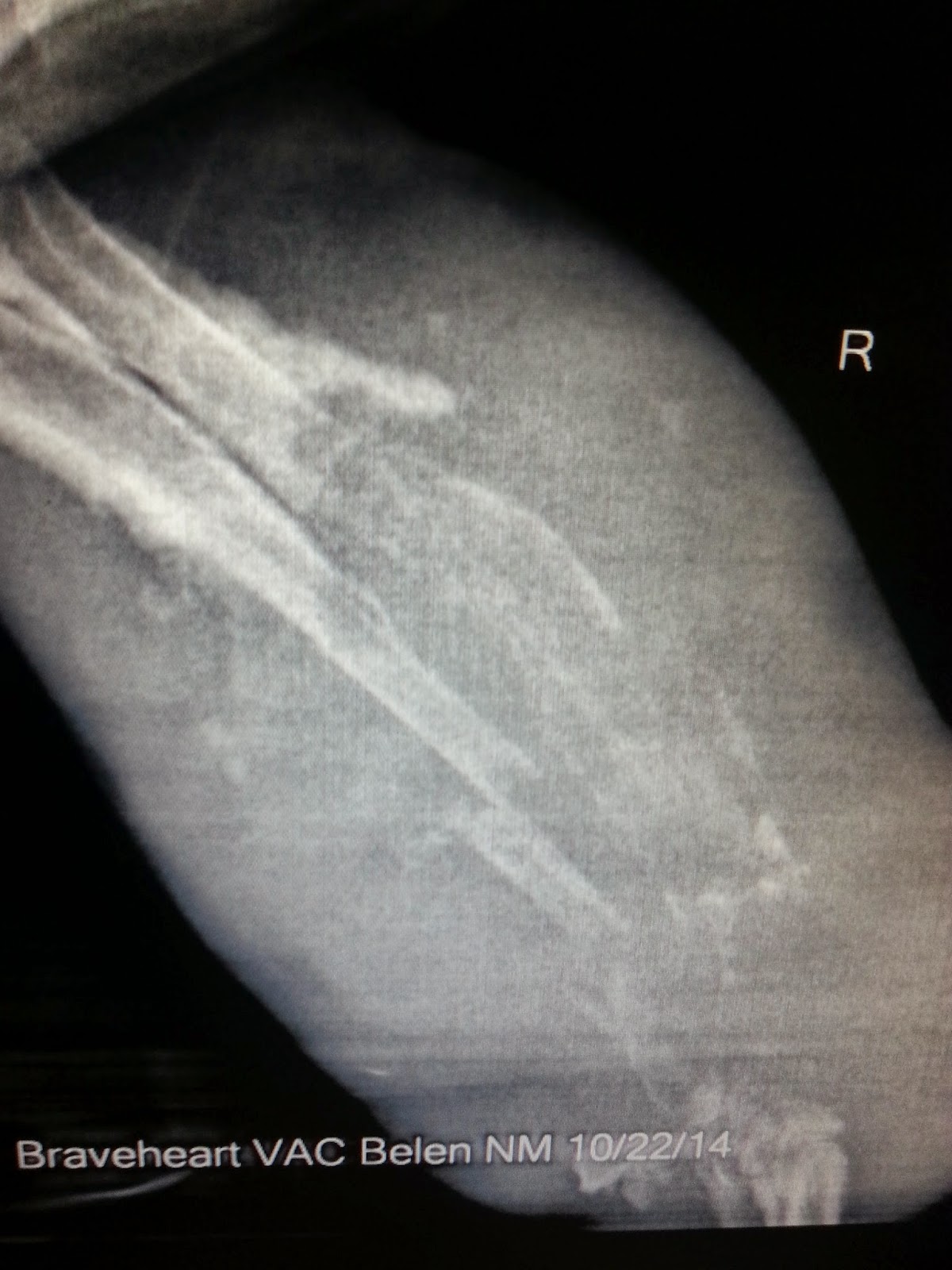
Pet Cancer Awareness: Braveheart and Bone Cancer
Braveheart is an Irish Wolffound with Osteosarcoma, also known as Bone Cancer, in his right front leg.


Description- Osteosarcoma is the most common primary bone tumor found in dogs. It accounts for upto 85% of all malignancies originating in the skeleton. It mostly occurs in middle aged to older dogs, with a median age of 7 years. Primary rib OS tends to occur in younger adult dogs with a median age of 4.5 to 5.4 years. Larger breeds have a high propensity for the disease. Dogs like Great Dane, Irish setter, Doberman pinscher, Rottweiler, German Shepherd and Golden Retriever are at greater risk of contracting osteosarcoma because of their size and weight.
If you have any questions about osteosarcoma and dogs, call Valencia Animal Clinic today!
SOURCE: http://www.wearethecure.org/osteosarcoma


Description- Osteosarcoma is the most common primary bone tumor found in dogs. It accounts for upto 85% of all malignancies originating in the skeleton. It mostly occurs in middle aged to older dogs, with a median age of 7 years. Primary rib OS tends to occur in younger adult dogs with a median age of 4.5 to 5.4 years. Larger breeds have a high propensity for the disease. Dogs like Great Dane, Irish setter, Doberman pinscher, Rottweiler, German Shepherd and Golden Retriever are at greater risk of contracting osteosarcoma because of their size and weight.
If you have any questions about osteosarcoma and dogs, call Valencia Animal Clinic today!
SOURCE: http://www.wearethecure.org/osteosarcoma
Thursday, September 18, 2014
Is Your Cat Missing the Litter Box?
The urinalysis will determine if blood, bacteria, or urinary crystals are present — signs that your cat might have feline lower urinary tract disease (FLUTD). FLUTD is very common and can cause painful urination. Cats that begin to associate the litter box with pain will avoid it. Other medical possibilities include hyperthyroidism, kidney disease, diabetes, and arthritis and muscle or nerve disorders that might prevent your cat from getting to the litter box in time. Environmental factors If there is no medical cause, the next step is to look at environmental factors. Start with the litter box.
Your cat might be avoiding the litter box because it is not cleaned well enough, you’ve changed the type of litter you use, or there is only one box for multiple cats. Another possibility is that your cat is “marking” — spraying urine, typically on vertical objects such as walls and furniture, or in “socially significant” areas near doors or windows. Both male and female cats mark. The most common offenders are cats that have not been spayed or neutered. Buffington says that stress can cause elimination problems too. For example, subtle aggression or harassment by other house cats or neighborhood cats may be an issue. Indoor Cat Initiative Even unremarkable changes in your home can make your cat anxious or fearful. Look around. Did anything change right before your cat started having problems? Did you get a new pet? A new couch? Maybe you just moved the old couch to a different part of the room, or had a dinner party. Cats are sensitive creatures and changes that seem small to you can throw your cat off his game. Check with your veterinarian about finding solutions that work for both you and your cat.
Source: http://www.aaha.org/pet_owner/pet_health_library/cat_care/behavior/missing_the_litter_box.aspx
Tuesday, August 12, 2014
Back to School Separation Anxiety
With all the excitement of the kids going back to school, many
families may not think about what it means to the dog or cat. What you may
notice are changes in behavior, a sad dog or cat, who mopes around or sleeps a
lot more. Or your dog may suddenly started chewing things he shouldn't, or your
cat does a lot more meowing. And you may not even connect the unusual cat or
dog behavior with back-to-school time. Dogs and cats love routine, it makes
them feel secure. They like knowing that certain things happen at about the
same time each day, and they know where they want to be when it happens. If the
kids have been around all summer, playing outside with the dog, or giving kitty
extra love and snuggles, and suddenly they’re gone all day, it's upsetting. For
some pets, they just feel sad and confused, and others feel real separation
anxiety and may act up.
Kids can help your pet through the back-to-school blues The first
thing to note is that this is a family matter, and a good opportunity for the
kids to take more responsibility for the care of their pets. Let your kids know
that their dog or cat is going to miss them when they're gone all day, and
discuss what they can do to help their pets through it. One of the best ways
for a pet to get over the loss of one routine is to replace it with another.
Your pet may be sad all day at first, but if he knows that at 3:45 your kids
will be home from school and will actively play with him soon after each day,
your pet has something new to look forward to. If your child has a set time to
do homework or read, that's an excellent time for the dog or cat to curl up
next to her and "help" with studying. Ask your kids to think of other
ways to include their pets in their routines.
More than just sad, it’s separation anxiety If your pet exhibits
true separation anxiety, as in, he goes crazy when he sees your kids put on
their backpacks to leave for school, or is destructive when everyone is gone,
you'll have to do some gentle training to ease his stress. Your kids may feel sorry
for their pet and do a long sad goodbye. This only reinforces your pet’s fears
and builds up the anxiety. It’s better to make the goodbye upbeat and brief, or
eliminate it completely. Depending on your pet, he may respond well to a
goodbye petting, a little goodbye treat, or simply leaving with a cheerful
"good boy!" as your kids go out the door. This should happen before
your pet gets upset. If your pet is freaking out, absolutely do not reward with
anything. If you can get your pet to calm down รข“ if it’s a dog, a simple
"sit!" command may help. Then reward with petting and telling him
he's ok once he’s calm. If your pet gets upset just by the backpacks or car
keys being picked up, pick those items up and walk around the house with them
several times a day, but don't leave. Your pet will learn not to associate
those items with the pending doom of your kids leaving.
When back-to-school means an empty house If everyone is gone all
day, both parents included, your pets are going to be bored on top of being
upset. It's important to leave them some interactive toys to help them pass the
time. Eventually, they will get used to the new reality, and will likely sleep
most of the day. You can balance the boredom by providing vigorous exercise
each day when you or your kids are home. Remember, you and your kids may have
had a very busy day, but your pet has done virtually nothing, unless there is
evidence to the contrary, as in a shredded or chewed up sofa. Providing your
dog or cat active, vigorous play each day will help them burn up their pent up
energy. Take your dog for a run or go outside and throw a ball or flying disk.
For your cat, run around the house with a little toy on the end of a string.
You may also want to consider getting your pet a little buddy to keep him
company when no one is home. Even an aloof adult cat is likely to accept a
kitten into her life, and the kitten will entice the older cat to play. And
dogs, being true social animals, nearly always accept another dog to play with.
Remember, your pets can get nervous, upset, anxious or lonely just like people,
only they don't have the benefit of knowing that you’ll be back when you leave.
It's up to you and your kids to make your pets feel secure in ways they
understand.
Source: http://www.petcentric.com/08-24-2009/your-pets-view-of-kids-going-back-to-school
Tuesday, July 29, 2014
Caring for pets during emergencies
Nothing says it better than the horror story from Hurricane Floyd:
A man was leaving his flooded home when he noticed a neighbor’s dogs swimming
in circles around the yard. Wondering why the dogs didn’t simply swim to
safety, the man swam over to investigate. To his horror, he found that the dogs
had been left chained to a stake in the yard and were swimming frantically just
to stay alive. He was able to rescue the dogs, but stories such as this
pointedly demonstrate the need for to you to have a good action plan in place
in case a natural disaster strikes your home. In this case, the dogs’ owner
most likely had been told to leave everything behind and flee as quickly as
possible. Unfortunately, his dogs nearly lost their lives as a result.
In the event of an emergency, your life and your family’s lives
are the first you should be concerned with. You should only look to save your
animals once you are sure you and your family will be safe. But once you are
safe, you most likely will want to ensure the safety of your pets. Are you
prepared?
Consider your location
First things first. You can only be prepared with a plan of action
if you know what you’re planning for, so take some time to think about the area
you live in. Some areas are naturally prone to certain disasters California ’s
earthquakes, for example. Find out what types of disasters have previously
struck your area hurricanes, floods, tornadoes, earthquakes, blizzards, etc.
Contacting your local emergency management office or Red Cross will help you to
identify what could affect your particular neighborhood. You should also plan
for non-natural disasters fires, gas leaks, chemical spills, etc. If, for
example, there’s a big chemical processing plant in your area, then you need to
be aware of the possible dangers so that you can react if need be. No matter
where you live, you’ve got your own special brand of disaster just around the
corner, and it may strike at any time.
If You Leave, They Leave
In the event that you have to leave your home, take your pets with
you. If it isn’t safe for you to be there, it isn’t safe for them either. Too
often people rationalize that their pets’ instincts will kick in, and they’ll
be okay. Even if your cat, who has spent the last six years of his life hunting
only the fake mice you pull around on a string for him, does have the instincts
to survive, it doesn’t mean that the conditions are survivable. No drinkable
water for you means no drinkable water for him too. Of course, you have to have
somewhere to take your four-legged friends--Red Cross disaster shelters cannot
accept pets. Make a list of all the places with in a 100-mile radius of your
home where you might be able to take your pet if the need arises, include
boarding facilities, veterinarians with boarding capabilities, hotels that will
accept pets (ask if they’ll allow pets during a disaster situation), and animal
shelters. (Use animal shelters only as a last resort, as they will be
overburdened with other animals whose owners did not plan for them). Also, you
need to gather your critters inside the house as soon as you are aware that you
may have to leave, so that you can easily get them when it’s time to go. Then,
when you do leave, make sure you have your little friends under firm
control--even the best behaved dog can become scared during an emergency,
making his behavior less than predictable.
Be prepared
Like a Boy Scout, you should always be prepared. This means having
a disaster kit in your home as well as a smaller version in the trunk of your
car if your pet routinely rides with you. Make sure that your pet’s kit is
contained in something that is easy to pick up quickly and take out the door
with you. You should replace this food and water every six months and rethink
your pet’s needs for the kit once a year to make sure that the supplies meet
your current needs the same collar that fits your new kitten is not likely to
fit him a year later.
The kit should include a week’s supply of food and water in
nonbreakable, airtight containers to ensure safety and freshness. If you pack
canned food you’ll want to make sure you have a hand-held can opener too. And
don’t forget a plastic dish that can double as a food and water dish. An extra
collar and leash are also important things to have in your kit. You should also
have a portable kennel for each of your critters handy. The San Francisco
Society for the Prevention of Cruelty to Animals says that the official Red
Cross policy is that there are no animals allowed in emergency shelters, but
they have been known to make exceptions if the animal is securely confined.
Pets such as birds will obviously have to have a carrier of some sort as they
cannot be leashed. You will want to make certain that you have a well-stocked
first-aid kit for your pet that includes tweezers, gauze bandages, first aid
cream, antiseptic spray, and hydrogen peroxide. Ask your veterinarian about
storing any medications that your pet may need to take regularly.
All the right papers
Many people have their home telephone numbers on their pets’ ID
tags. You may want to have an extra set of tags made that list the number of a
friend or family member outside the area so that if your phone lines are down,
or you’ve been evacuated, your pets can still make it back to you. Another
option is to simply include an out-of-area number on your pets’ everyday tag,
which can be useful if you’re away on vacation too. And many people don’t have
tags for their cats at all, even though they should. According to the 1996
National Council on Pet Population Study, out of one million dogs and 580,000
cats that were taken in as strays, only 17 percent of the dogs and two percent
of the cats made it back to their owners. The American Humane Association
strongly believes that tags are your pets’ ticket home. You may also want to
consider having your pet microchipped or tattooed. And finally, don’t forget
the paperwork. Have a copy of your pet’s recent vaccination records in your
kit--some boarding facilities may require them before they will take your pet
in. A recent picture of your pet may also come in handy if you should become
separated and need to make "Lost" posters. Hopefully you won’t ever
have to put them up, and hopefully you’ll never have to use your disaster plan.
But if you do ever need it, you’ll be very thankful that you were prepared; it
could make a trying time a bit easier for you and your faithful companion.
Thursday, July 10, 2014
State, Regional Health Departments Warn Residents about Tularemia
FOR IMMEDIATE RELEASE:
Media Contact: David Morgan, DOH
July 10,
2014
Office: 575-528-5197
Dr.
Paul Smith, City of Albuquerque
Office:
505-452-5301
State,
Regional Health Departments Warn Residents about Tularemia
65
year-old Bernalillo County woman first human case of 2014
(Santa Fe) – The New Mexico Department of Health announced today a
laboratory confirmed case of tularemia in a 65 year-old woman from Bernalillo
County. The cause of the woman’s illness was confirmed at the Department’s
Scientific Laboratory Division. The woman was hospitalized but has recovered
and gone home.
“We will be following up with a case investigation later this week
in an effort to prevent future infections,” says Dr. Paul Smith, Urban
Biology Division manager for the City of Albuquerque’s Environmental Health
Department.
There have also been 7 pet cases of tularemia this year, 4 dogs
and 3 cats from Santa Fe, Bernalillo, and Los Alamos counties.
“Tularemia can cause serious illness in both people and pets so I
would encourage people around the state to follow precautions similar to
reducing risk to plague,” said Department of Health Cabinet Secretary, Retta
Ward, MPH. “Don’t handle sick or dead rodents, don’t allow pets to roam and
hunt, get an appropriate tick and flea control product for pets, and take sick
pets to a veterinarian. Since tularemia can be fatal in a small percentage of
cases, it should be treated with antibiotics following an evaluation by a
physician.”
Tularemia is caused by a bacteria found in animals, especially
rodents, rabbits and hares. Tularemia can also make dogs and cats sick and they
can give the disease to people. Symptoms of tularemia in people usually develop
3 to 5 days after exposure but onset can vary from 1 to 14 days.
Tularemia symptoms are similar to plague infection including
sudden fever, chills, headaches, diarrhea, muscles aches and joint pain. Other
symptoms of tularemia depend on how a person was exposed to the tularemia bacteria
and can include pneumonia and chest pain, ulcers on the skin or mouth, swollen
and painful lymph glands, swollen and painful eyes, and a sore throat.
“Many areas of the state have seen a large increase in the rabbit
population this year and now some of those rabbits are getting sick and dying
from both tularemia and plague,” said Dr. Paul Ettestad, the Department of
Health’s public health veterinarian. “Often times there is a rabbit or
rodent die off in an area due to tularemia and deer flies or ticks can become
infected from these animals and then pass it on to pets or people when they
bite them.”
People can get tularemia in different ways: handling infected
animal carcasses; being bitten by an infected tick, deerfly or other insect;
eating or drinking contaminated food or water or by breathing in the bacteria.
Dogs and cats are usually exposed to tularemia when they are allowed to roam
and hunt sick rodents and rabbits or when bitten by an infected tick.
In 2013 there were 4 human cases of tularemia identified in New
Mexico, a 45-year-old man from Santa Fe County, an 88-year-old woman from
McKinley County, a 62-year-old woman from Santa Fe County and a 75-year-old
woman from San Juan County. Three of the human cases were hospitalized
and all recovered.
For more information on tularemia visit http://www.cdc.gov/tularemia/.
Tuesday, May 13, 2014
Dog Safety Tips for Memorial Day
1. Keep your pet indoors at all times, if possible.
2. Use Pet Friendly Repellent.
3. Don’t give your pet table food. Source: http://tiny.cc/4x14ex
Subscribe to:
Posts (Atom)